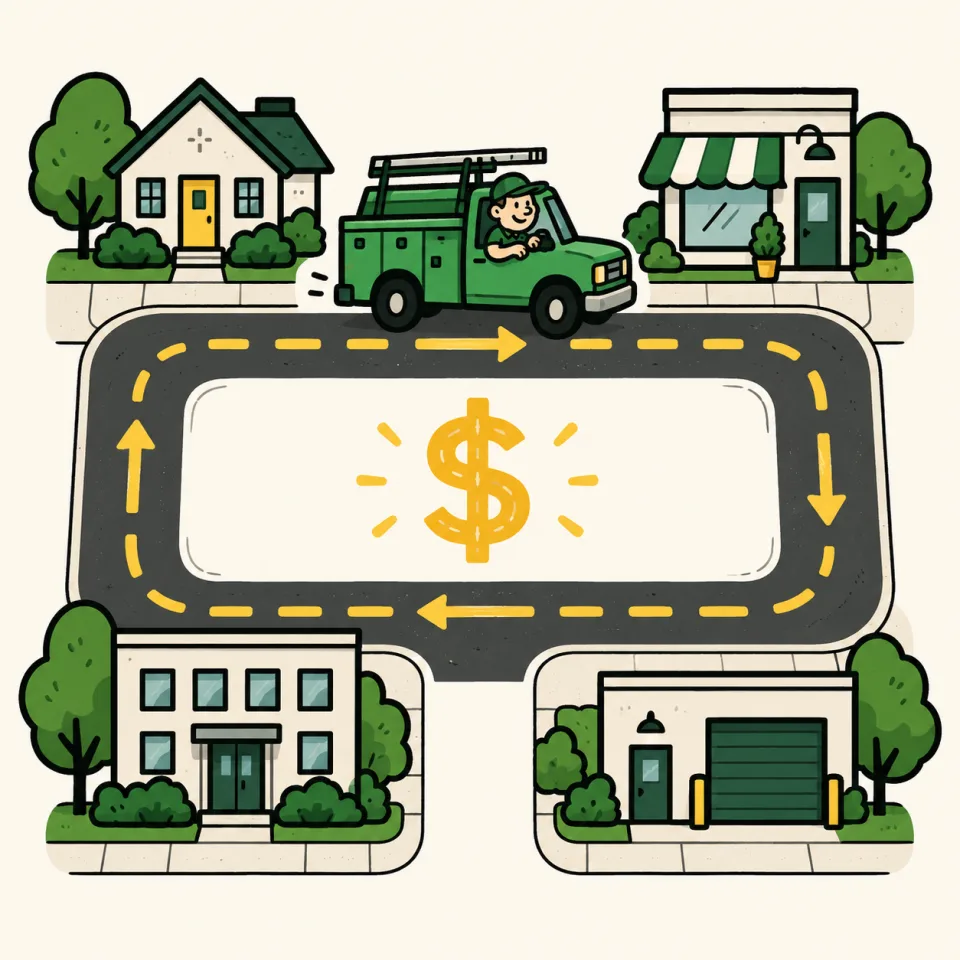

The best ugly business is not the one with the biggest headline number. It is the one you can tolerate at 6:40 a.m., in a loading dock, while someone named Gary explains that the previous vendor was cheaper and also terrible.
This field guide is a decision framework. Not inspiration. Inspiration is how people buy equipment before learning that restaurants pay slowly.
Start With the Stomach Test
Every ugly business has a texture. Some are dirty. Some are boring. Some are bureaucratic. Some require you to be alone in a ceiling cavity wondering if civilization was a mistake.
The stomach test asks one question: Can you do the unpleasant part repeatedly without becoming unreliable?
That matters more than the logo, website, truck wrap, or your heroic spreadsheet.
Take Commercial Hood Cleaning. Typical operators report startup costs around $6k-$25k, margins near 30%, and revenue potential of $120k-$450k/yr solo-to-small crew. Good numbers. Also: grease, late nights, ladders, restaurant kitchens, and the faint sense that every surface has a legal defense team. If you cannot handle physically messy work after closing hours, the margin is not your margin.
Now compare that with Backflow Testing Route Service. Typical operators report $2.5k-$12k in startup costs, margins around 45%, and $80k-$300k/yr solo revenue potential. Less gross. More clipboard. More testing appointments. More municipal compliance. If your stomach is fine with procedure, forms, and showing up on time, this may fit better than heroic pressure washing at midnight.
The stomach test is not about toughness. It is about fit.
Ask yourself:
- Can I do the core task on a bad day?
- Can I sell it without pretending it is glamorous?
- Can I hire and train someone else to do it without apologizing for the work?
- Can I handle the customer type this business attracts?
- Can I still care after the novelty dies, which should take roughly eleven minutes?
Dirty work is not automatically bad. Boring work is not automatically easy. Regulated work is not automatically stable. The question is which flavor of ugly you can operationalize.
Then Run the Capital Test
Capital does not just decide what you can afford. It decides how much pain you can survive before revenue becomes predictable.
Ugly businesses often look cheap from the outside because the work is simple to describe. Then reality arrives wearing steel-toe boots: insurance, tools, certifications, backup equipment, storage, repairs, uniforms, software, fuel, and the first month where three customers say payment is coming Friday.
Use price tiers as a sanity filter.
Low-Capital Ugly: Under About $5k to Start
This tier is best when you need proof before pride. You want to sell, learn, and avoid owning a garage full of specialized regret.
FOG Compliance Logbook Service sits nicely here. Typical operators report startup costs of $2k-$12k, margins around 50%, and $60k-$220k/yr solo potential. The work is not cinematic. It is paperwork for grease. But the low-end capital requirement lets you validate demand before building an empire of binders.
Industrial Labeling and Safety Signage is another practical option, with typical startup costs around $3k-$25k, margins near 40%, and $80k-$350k/yr solo-to-small shop potential. You are putting labels, signs, and warnings where industrial customers need them. Not glamorous. But neither is a pipe with mystery contents.
Commercial Door Hardware Repair can also begin lean, with typical operators reporting $4k-$25k in startup costs, 40% margins, and $100k-$450k/yr solo-to-small crew potential. The early version is tools, parts, competence, and a phone that gets answered. Doors fail in boring ways. Boring failures pay invoices.
Low-capital ugly is not low-effort ugly. It usually means you are paying with sales effort, scheduling discipline, and personal labor instead of equipment financing.
Middle-Capital Ugly: Roughly $5k-$30k
This is where many serious solo-to-small-crew businesses live. Enough equipment to look real. Not so much equipment that the business becomes a debt instrument with a website.
Fire Extinguisher Inspection Routes is a classic middle-tier candidate. Typical operators report $5k-$30k in startup costs, margins around 35%, and $90k-$350k/yr solo-to-small crew potential. The work is route-friendly, compliance-driven, and recurring. You sell the peace of mind that comes from a sticker no one thinks about until an inspector does.
Parking Lot Striping typically starts around $4k-$22k, with margins near 40% and revenue potential of $100k-$500k/yr seasonal solo-to-crew. The appeal is visible work and relatively clear scope. The tradeoff is seasonality, weather, pavement conditions, and the joy of explaining that straight lines are easier when cars are not parked on top of them.
Warehouse Rack Inspection and Repair typically reports $5k-$30k startup costs, 35% margins, and $120k-$500k/yr specialist crew potential. It rewards technical credibility and risk awareness. Forklift damage is common. Gravity remains undefeated.
This tier demands a harder question: Do you have enough capital to be professionally useful before you are comfortably profitable?
If the answer is no, start smaller. A half-equipped compliance business is not scrappy. It is a future apology.
Higher-Capital Ugly: $30k-$75k and Beyond
Higher-capital ugly can work beautifully when the demand is recurring, the rules are hard enough to deter casual entrants, and the customer pain is expensive.
Medical Waste Pickup for Small Clinics is a serious example. Typical operators report startup costs of $15k-$75k, margins near 30%, and $180k-$800k/yr regulated route business potential. It has recurring demand and clear customer need. It also has serious rules, logistics, containers, documentation, and compliance expectations. Tiny red bins. Very adult consequences.
Warehouse Concrete Joint Repair typically reports $15k-$70k startup costs, margins around 24%, and $200k-$900k/yr small-crew potential. The revenue potential is attractive. The margin is thinner than some lighter services. That means estimating, labor control, materials, and scheduling matter. You are not just fixing floors. You are managing production.
Commercial Floor Mat Service can require $10k-$60k to start, with margins around 30% and $150k-$650k/yr route business potential. It sounds simple because mats are simple. Then you remember washing, swapping, inventory, vehicles, route density, and customers who somehow treat floor mats as both invisible and urgent.
Higher capital can buy a better moat. It can also buy a more expensive mistake.
The Route-Density Test
Many ugly businesses are not really service businesses. They are routing businesses wearing service-business clothes.
The route-density test asks: Can you stack enough nearby stops to make the day profitable?
A single customer across town is not a customer. It is a field trip with an invoice attached.
Route density matters most when the job value is moderate, the visit is recurring, and travel time can quietly eat the business. Forklift Battery Maintenance is a good example. Typical operators report startup costs around $8k-$35k, margins near 25%, and $120k-$500k/yr route-based potential. The work can be repeatable and valuable, but the route has to make sense. One warehouse on Monday, another 70 minutes away on Tuesday, and a third on Friday is not a route. It is a cry for help with fuel receipts.
The same logic applies to fire extinguishers, floor mats, backflow testing, medical waste pickup, and FOG compliance. The service may be different. The math is similar.
You want clusters:
- Restaurants on the same commercial strips.
- Clinics in the same medical corridors.
- Warehouses in the same industrial parks.
- Retail locations with repeated compliance needs.
- Multi-site customers who can be sold once and serviced many times.
Route density also changes sales strategy. You do not just ask, Who needs this? You ask, Who needs this near someone else who needs this?
That is why an ugly business can look mediocre in one market and excellent in another. A sparse town can make a good service bad. A dense industrial corridor can make a boring service quietly wonderful.
Before picking the business, map the customer geography. Not with heroic precision. Just enough to see whether your future workday is a route or a punishment.
The License Test
Licensing and compliance are usually discussed as barriers. That is too flattering. Sometimes they are barriers. Sometimes they are toll booths. Sometimes they are a polite sign telling you the business is not for tourists.
The license test asks: Are the required credentials annoying enough to protect the business, but not so annoying that they stop you from starting?
Industrial Scale Calibration is a clean example of a technical ugly business. Typical operators report startup costs of $12k-$55k, margins around 28%, and $150k-$650k/yr solo-to-crew potential. Customers care because inaccurate scales create expensive problems. The work needs trust, process, and accuracy. Being off by a little can mean buying imaginary flour. Beautiful sentence. Terrible procurement outcome.
Fire Damper Inspection Service has another kind of compliance profile. Typical operators report $10k-$45k startup costs, margins near 30%, and $160k-$700k/yr solo-to-crew potential. The work exists because buildings, insurers, and safety rules do not care about your fear of ceiling spaces. That is good. Demand created by rules can be durable. But you must respect the rules, the documentation, and the inspection process.
Pallet Repair and Recycling is different. Typical operators report $8k-$50k startup costs, 25% margins, and $150k-$700k/yr small yard potential. The moat may be less about licenses and more about yard space, logistics, supply relationships, buyers, equipment, and operational grit. Broken wood does not ask for credentials. It asks for process, throughput, and tetanus-adjacent common sense.
License-heavy does not always mean better. License-light does not always mean worse. The question is whether the friction improves your odds.
Good friction:
- Keeps casual competitors away.
- Makes customers value documentation.
- Creates recurring deadlines.
- Supports premium pricing when competence is obvious.
Bad friction:
- Requires capital you do not have.
- Delays launch for months with no learning.
- Adds liability you do not understand.
- Forces you into customer segments you cannot reach.
A good ugly business has friction you can climb. Not friction you admire from a distance.
Match Business Type to Your Personal Defects
This is the part people avoid because it is rude and useful.
Your best ugly business should fit your defects.
If you hate mess but like procedures, look at compliance, testing, inspection, signage, or calibration. Backflow, fire extinguishers, industrial labeling, and scale calibration may fit.
If you can handle physical work and odd hours, hood cleaning, concrete joint repair, door repair, and rack repair become more interesting.
If you like routes and operational repetition, floor mats, medical waste, forklift batteries, and extinguisher inspections deserve a closer look.
If you need low capital and fast market feedback, FOG compliance, backflow testing, industrial labeling, and commercial door hardware are more forgiving places to begin.
If you have capital, tolerance for rules, and patience for slower setup, medical waste, fire damper inspection, scale calibration, and concrete joint repair may offer bigger ceilings.
There is no universally best ugly business. There is only the best match between:
- Your capital.
- Your tolerance for dirt.
- Your tolerance for paperwork.
- Your ability to build routes.
- Your local customer density.
- Your willingness to be professionally boring for years.
That last one is the real moat.
Examples by Operator Type
The solo operator with limited capital should avoid pretending to be a fleet. Start where sales and reliability matter more than assets. FOG compliance, backflow testing, industrial labeling, or door hardware repair can let you learn quickly without betting the house on equipment.
The hands-on operator who wants stronger job tickets can consider hood cleaning, rack repair, fire damper inspection, or warehouse concrete joint repair. These usually require more skill, more physical tolerance, and better estimating. The upside is that customers often have clearer pain and fewer cheerful alternatives.
The route builder should obsess over density before anything else. Floor mats, medical waste pickup, forklift battery maintenance, fire extinguisher inspections, and FOG compliance can all work when the stops are tight. Spread them out too far and the route becomes a sightseeing business with worse margins.
The compliance-minded operator should look for recurring deadlines. Backflow tests, extinguisher inspections, fire damper inspections, scale calibration, and medical waste pickup all benefit from customers who must keep records. The customer is not always buying joy. Often they are buying the ability to stop worrying about an inspector.
The small-yard operator may find pallet repair and recycling attractive if they can handle space, sourcing, repair flow, resale channels, and labor. It is not elegant. It is wood, nails, sorting, pickup, and repeat. Elegance is rarely asked to pay rent.
The Final Filter
After you shortlist a few businesses, score each one from 1 to 5 on four tests:
- Stomach: Can I actually do the ugly part?
- Capital: Can I start properly and survive the ramp?
- Route density: Are enough customers close enough together?
- License: Is the friction useful, manageable, and worth it?
Then remove any option with a 1 in any category. A business that fails one core test is not a diamond in the rough. It is rough.
For the remaining options, do the least romantic thing possible: talk to customers. Ask what they use now, what they hate, how often they need the service, and what makes a vendor unacceptable. The ugly business usually reveals itself in complaints. Customers will rarely say, Please sell me a recurring compliance service. They will say, The last guy never showed up, and our inspection is next month.
That is the opening.
The bottom line
Pick the ugly business you can repeat, fund, route, and legally operate. The best one is not the prettiest opportunity. It is the one where your personal tolerance lines up with boring customer pain.
That is where the invoices live.