
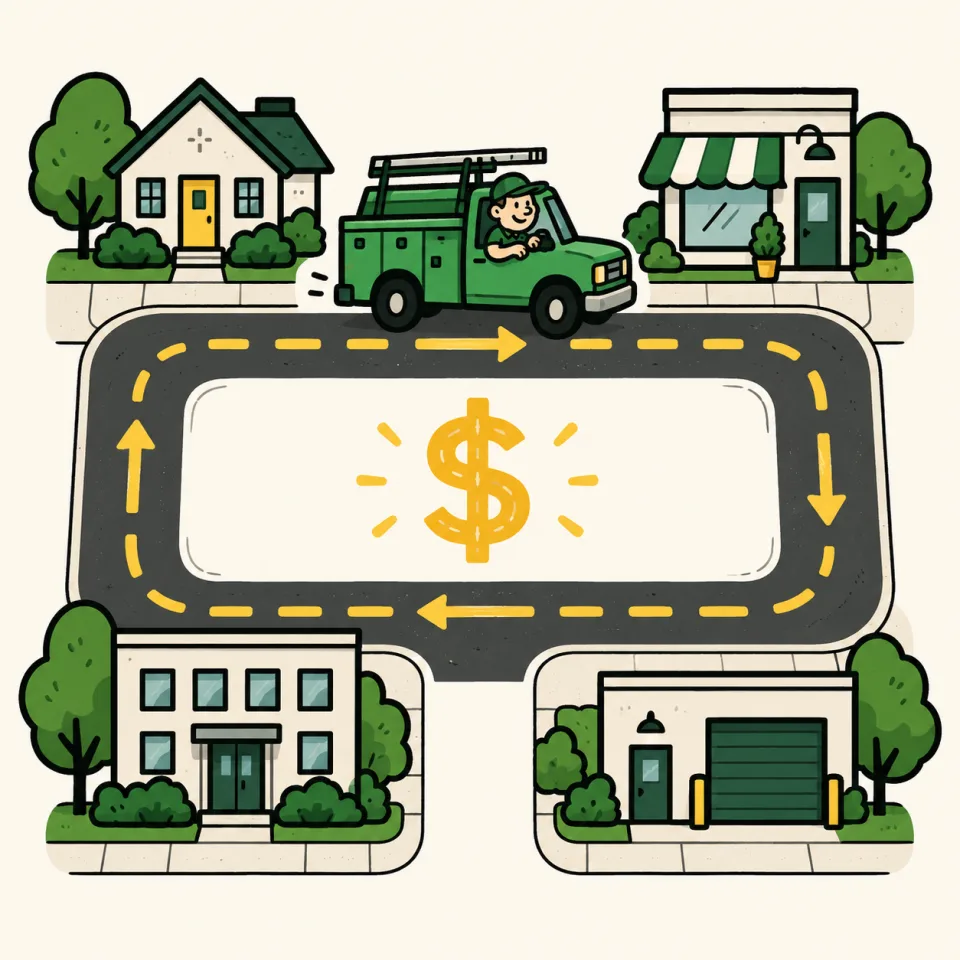
A truck that is fully booked can still lose money. If the crew spends half the day crossing town, the calendar looks healthy while the route is not. Route density asks a sharper question: how much contribution does each paid stop produce per hour the vehicle and crew are committed?
Measure the whole route day
Start a simple log for two weeks. Record departure and return time, miles, paid stops, on-site minutes, unload or disposal trips, callbacks, and collected revenue. Then subtract direct labor, vehicle costs, job supplies, disposal or vendor fees, and payment charges. Divide the remaining contribution by total route hours—not just billable hours. Include owner field labor at a realistic rate, even if you are not yet drawing that wage.
Suppose a sample day collects $1,200 from six stops and has $610 in direct costs. Contribution is $590. If the route consumes ten hours, that is $59 per route hour before office overhead, taxes, and owner profit. A tighter route with five stops could win if it returns more contribution in fewer total hours. Those figures are an illustration, not a benchmark for your market.
Build zones around actual buyers
Plot your last 30 jobs on a map and mark their contribution, not merely their revenue. Circle clusters where travel between stops is short and the buyer type repeats. Give each zone a service day or a booking window. When someone outside the zone asks for an urgent visit, quote the extra travel explicitly instead of letting the schedule absorb it.
- Track revenue per stop, contribution per stop, total route hours, and contribution per route hour.
- Separate paid work from drive time, loading, dumping, supply runs, and callbacks.
- Compare one proposed cluster with the route it would displace.
- Test a new zone with rented capacity or a limited service day before committing another vehicle.
The decision rule
Add a route only when repeat demand, access windows, vehicle capacity, and a downside case support it. A map full of pins is not a route. A route is a repeatable sequence of paid stops that leaves money after direct costs and enough room for overhead. If it only works with perfect traffic and no cancellations, keep improving the first cluster.
For the broader screening process, see how to choose an ugly business and businesses that scale with routes. The SBA startup-cost guide is a useful reminder to include vehicles, insurance, wages, and working capital before calling a route profitable.